
Criminal Court Cases in Texas County
Texas County belongs to Missouri's 25th Judicial Circuit. Felony prosecutions proceed in Circuit Court. The Texas County Associate Circuit Division also hears criminal and traffic matters that fall within its statutory authority. Municipal courts handle city ordinance cases. This split matters because a person may find a city citation with the municipal court while a state charge tied to the same event appears in the Texas County circuit system.
The Texas County Circuit Clerk maintains criminal, traffic, juvenile, civil, probate, jury, and accounting records from the Justice Center's second floor. The clerk records filings, events, judgments, money assessments, and outcomes. The Associate Circuit Division explains the lower court's local role. Its official page is pictured below.
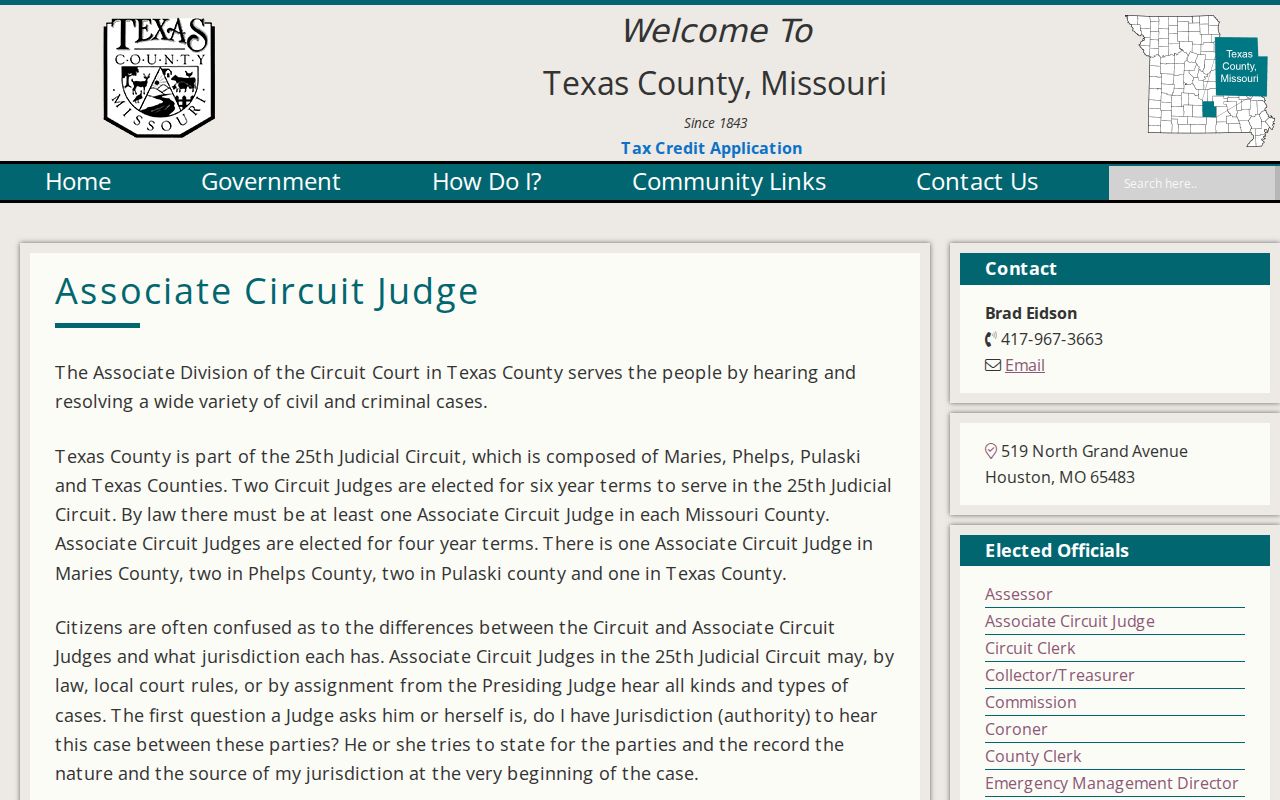
The court description helps readers route a Texas County case before they search, especially when the charge is criminal, traffic, or municipal.
Texas County Court Case Routes
Three local court paths can hold a criminal or ordinance file. Texas County Circuit Court handles felonies and other circuit matters. The Associate Circuit Division hears criminal and traffic cases within associate jurisdiction. Cabool, Houston, and Licking ordinance matters begin with their city or the court route that now serves that municipality. Licking's municipal division transferred to the associate circuit court in 2022, so an old assumption about a stand-alone city docket can misdirect a search.
| Court route | Typical record | Contact point |
|---|---|---|
| Texas County Circuit Court | Felony and other circuit case files | Circuit Clerk, Suite 202 |
| Associate Circuit Division | Associate criminal and traffic cases | Texas County Justice Center |
| Municipal route | City ordinance cases | Relevant city court or clerk |
When the same event has both local and state consequences, check each proper court. A city docket does not replace the Texas County prosecution file.
Texas County Case Record Searches
Missouri Case.net is the main free online channel. The Texas County clerk says a search limited to the 25th Circuit reflects entries in real time after staff add them. An All Participating Courts search can lag by as much as three hours. A complete case number is the strongest key. A name search works only when the person is indexed as a litigant, so some protected parties cannot be found by name.
- Open Case.net and choose Search for Cases.
- Select Litigant Name, Filing Date, or Case Number search.
- Choose Texas County or the 25th Judicial Circuit when that filter is available.
- Open the matching Texas County docket and review every charge count, event, judgment, and public document.
- Call or visit the Circuit Clerk when a file, certified copy, or archived paper is not available online.
| Field label | Type | Required | Notes |
|---|---|---|---|
| Search type | Tabs or links | One mode | Litigant Name, Filing Date, or Case Number |
| Court / location | Dropdown | Search dependent | Texas County, 25th Circuit, or All Participating Courts |
| Last / business name | Text | For litigant search | Party must be indexed as a litigant |
| First / middle name | Text | Optional | Helps narrow common names |
| Case type | Dropdown | Optional | Choose criminal or traffic where offered |
| Filing date range | Date controls | For date search | Use the live form's allowed range |
| Case number | Text | For number search | Enter the full Missouri case number |
Use a narrow Texas County filter when the event is known to be local. Broaden the search only when the person may have a case in another Missouri court.
Texas County Case Files Upstairs
The local fallback is concrete. The Texas County Circuit Clerk is at 519 N. Grand Ave., Suite 202, Houston, MO 65483. The counter is on the second floor and follows county hours of 8:00 a.m. to 4:30 p.m. on weekdays. Call 417-967-3742 before ordering by phone or mail. Ask whether the Texas County file is available, whether archive retrieval is needed, what plain or certified copies cost, and which forms of payment the office accepts. Local copy and certification fees were not published in the reviewed official material.
The official clerk page provides the source for this access route and the local Case.net timing note.
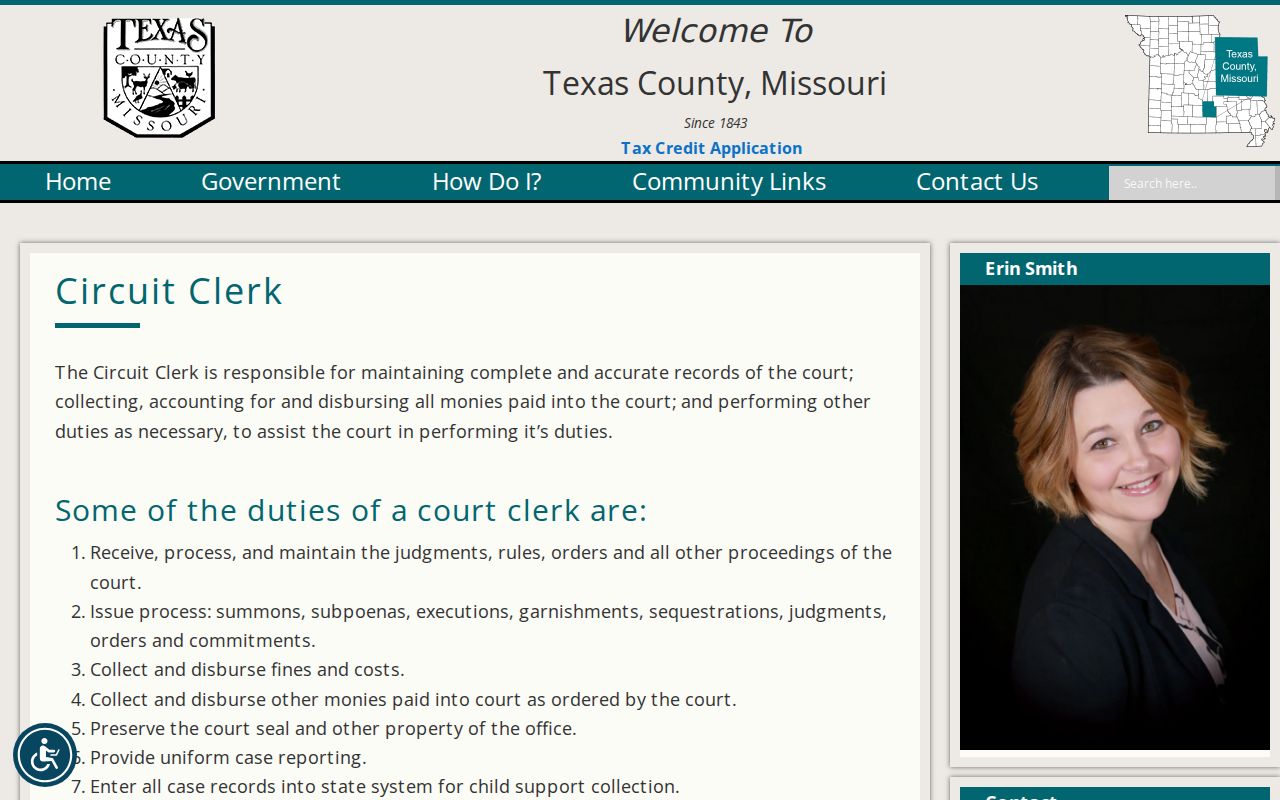
The clerk counter fills the gap when a Texas County case shell is public but an older paper, certified judgment, or remotely restricted document is not downloadable.
Texas County Circuit Clerk
519 N. Grand Ave., Suite 202
Houston, MO 65483
417-967-3742
Weekdays, 8:00 a.m.-4:30 p.m.
What a Criminal Case File Contains
A Texas County case file is the record of a prosecution, not a police narrative. Read the header first, then each count. The charge description, cited law, class, and outcome can differ across counts. Docket events show what occurred in court and when. A public case can include an attachment that remains confidential, and the absence of a document icon does not mean the whole case is closed.
| Case number and court | Identifies the Texas County matter, filing date, type, assigned division, and status. |
|---|---|
| Parties | Lists the State of Missouri, defendant, and public attorneys of record. |
| Charging document | States the complaint, information, or indictment and the filed counts. |
| Docket entries | Chronicles filings, hearings, continuances, pleas, warrants, and judgments. |
| Disposition | Shows the outcome of each count, such as conviction, dismissal, or acquittal. |
| Sentence and money | Records the sentence, assessments, credits, and public balance data when available. |
| Documents and schedule | Shows eligible public files and future event details. |
Note: A Texas County docket marked disposed must still be read count by count because disposed does not always mean convicted.
Reading Texas County Case Outcomes
Missouri court terms carry precise meanings. A dismissal ends a count without conviction on that count. An acquittal is a not-guilty decision. A nolle prosequi records the prosecutor's formal choice not to continue a charge. A suspended imposition of sentence, often called SIS, means the court does not impose sentence while the person completes set conditions or probation. A suspended execution of sentence, or SES, means a sentence was imposed but its execution was suspended during probation.
- Arraignment
- The hearing where the accused hears the filed charges and enters a plea.
- Disposition
- The recorded outcome of one charge, not merely the status of the full Texas County case.
- Docket
- The dated list of filings and court events.
- Capias
- Court process that directs a person be taken into custody.
- Sentence
- The court-ordered consequence after conviction.
Compare the filed charge with the final outcome. The prosecutor may file a different charge from the arresting officer's initial label. For the earlier event and custody trail, use the contextual Texas County arrest search, but rely on the court file for what prosecutors filed and what the judge decided.
Criminal Case Stages in Texas County
A Texas County criminal case may start with an arrest or summons. A judge then addresses initial appearance and bond. The prosecutor files a complaint or information, or a grand jury returns an indictment. Arraignment follows. Discovery, motions, and hearings build the pretrial docket. The matter then moves to a plea or trial, judgment, sentence, and any post-judgment motion or appeal.
Case flow: Charges Filed › Arraignment › Pretrial › Plea or Trial › Disposition › Sentencing
Case.net presents this sequence as coded docket entries, not as a plain account. Scheduled dates can change. Confirm a key hearing with the Texas County Circuit Clerk, especially when the docket shows a continuance or a recent entry.
Texas County Charges After Arrest
The Texas County Prosecuting Attorney has exclusive authority over state-law felonies in the county. The office also prosecutes state misdemeanors from unincorporated areas. Municipal prosecutors handle local ordinance cases. That division explains why the jail's arrest charge is not the final word. The prosecutor reviews the matter and decides whether to file, what count to file, or whether no state case should proceed.
The official prosecutor page describes that Texas County jurisdiction and the office's role in victim services.
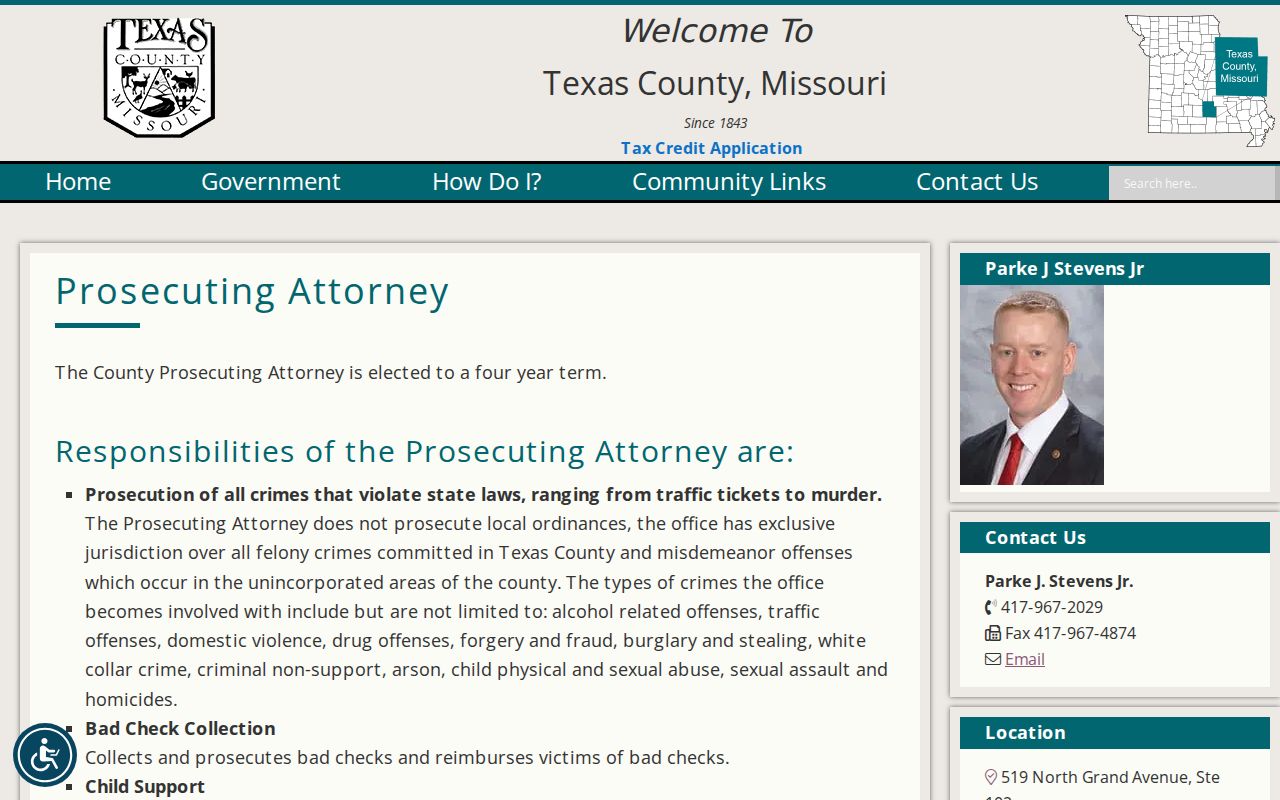
This separation is why a sound Texas County case review follows the filed complaint and disposition rather than stopping at a booking label.
Missing Texas County Case Documents
A visible Texas County case does not make every attachment available online. Missouri's remote public access expansion reached the 25th Judicial Circuit in 2025, but document eligibility still depends on court access rules. Confidential attachments, sealed files, juvenile matters, protected identifiers, and some victim data remain out of public view. Protected parties may also be excluded from a name search even when a known case number retrieves the public case shell.
Use the Case.net file viewer when an icon is present. If the icon is absent, contact the clerk and identify the case number and document sought. Court records follow judiciary access rules, including Missouri Court Operating Rule 2. Do not send a court-file request only to the sheriff under the Sunshine Law. The sheriff holds police, arrest, booking, and some warrant records, while the clerk holds the prosecution file.
Access Rules for Case Records
Public access in Texas County has limits. Juvenile files are ordinarily confidential. Expunged matters are closed to normal public access under Missouri law, though authorized agencies retain defined access. Confidential filings and protected personal details may be withheld or redacted. A case name that does not appear may reflect a search mismatch, protected-party rule, delayed filing, or lawful restriction. It is not proof that no event occurred.
Missouri court access: RSMo 610.011 favors open public records, while Court Operating Rule 2 governs judiciary access and confidentiality.
For a public Texas County file, begin with Case.net. Use the clerk counter for certified copies, archives, and documents not remotely eligible. Ask the city court about ordinance matters. Use MACHS only when the question concerns qualifying statewide repository history, because MACHS is not a substitute for the original Texas County case file.
Note: Open access never means every page is unredacted, downloadable, or searchable by every person's name.